Service Berths · S-00

Service berths for API and integration work

Each berth maps an incoming client load to a defined handling method and cleared business outcome. GARICHA LIMITED provides professional technology services across the full integration harbour.

Service berth overview

Our service model is built for organisations facing integration complexity — multiple platforms, evolving compliance requirements, and pressure to deliver digital capabilities without destabilising operations. Rather than selling disconnected deliverables, we assign work to berths with clear intake criteria, handling standards, and clearance definitions.

Core berths include API Development and Integration, Systems Integration Services, Cloud Computing Solutions, Web and Mobile Application Development, Enterprise Software Solutions, Database Design and Management, Cybersecurity Services, Network Infrastructure Solutions, Data Analytics Services, Artificial Intelligence and Machine Learning Development, DevOps and Automation Services, and Technology Strategy Consulting.
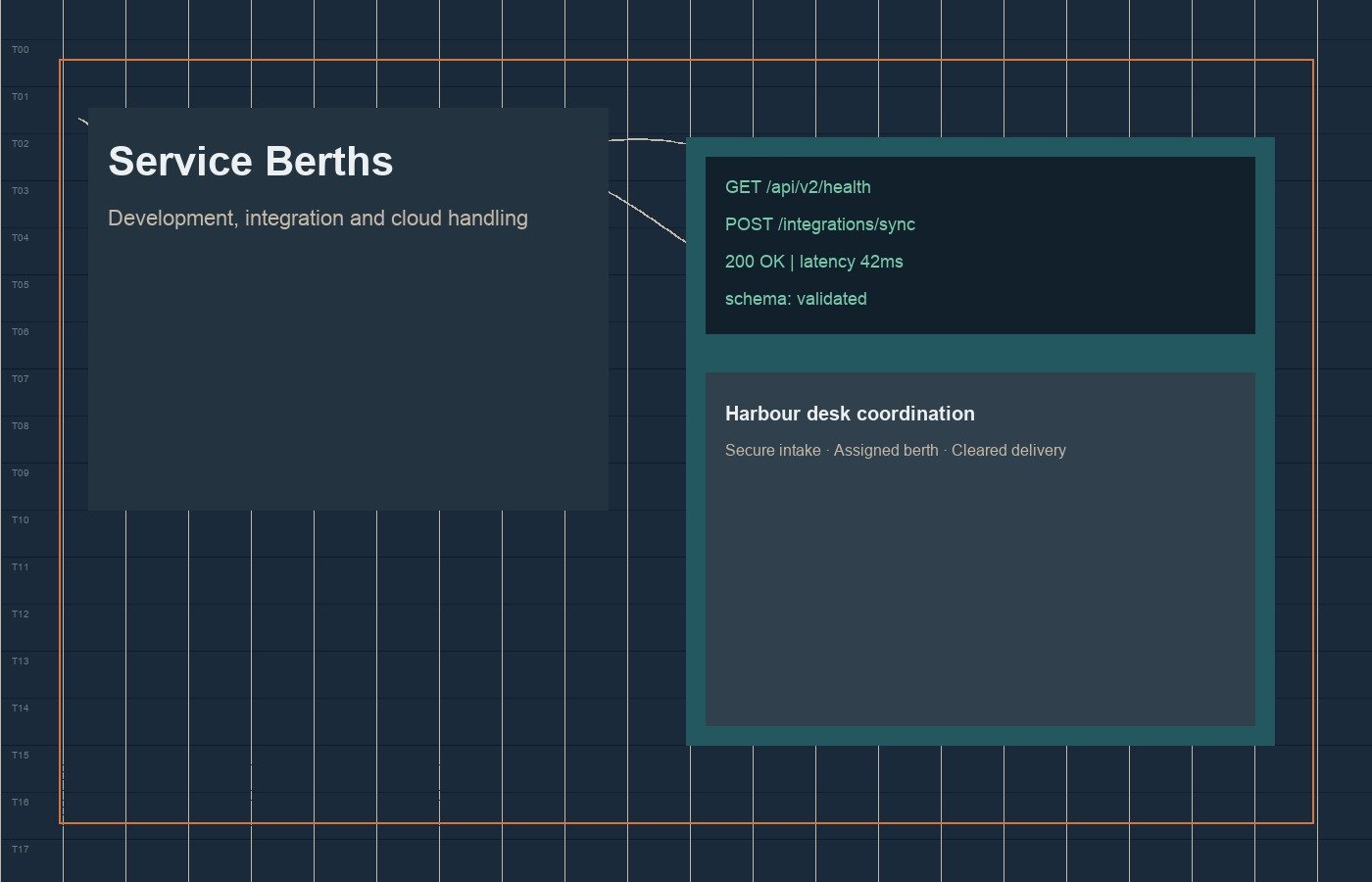
Service berth board showing API and integration categories

Detailed Berths

Incoming loads and handling methods

B-API · Primary
Incoming load

Undocumented or inconsistent APIs blocking partner and internal development.

Handling method

API design, OpenAPI specifications, versioning strategy, developer portals, and contract testing.

Included

Security patterns, observability, rate limiting, documentation, and handover workshops.

B-INT
Incoming load

Enterprise systems and SaaS applications that do not exchange data reliably.

Handling method

Integration architecture, message queues, ETL pipelines, and API mediation layers.

Included

Mapping documentation, error handling, monitoring dashboards, and support transition.

B-CLD
Incoming load

Manual deployments and infrastructure that cannot scale with API demand.

Handling method

Cloud migration, container orchestration, infrastructure as code, and environment standardisation.

Included

Security baselines, cost governance, and CI/CD integration for API releases.

B-SEC
Incoming load

APIs exposed without consistent authentication, authorisation, or threat modelling.

Handling method

Cybersecurity services including OAuth/OIDC implementation, secrets management, and penetration-informed hardening.

Included

Security review reports, remediation guidance, and ongoing advisory options.

B-DATA
Incoming load

Data trapped in silos with no governed API access for analytics or ML.

Handling method

Database design, data analytics services, pipeline orchestration, and ML-ready feature stores.

Included

Access controls, quality checks, performance tuning, and documentation for data consumers.

B-STR
Incoming load

Leadership needs a practical technology strategy for digital transformation.

Handling method

Technology strategy consulting, architecture roadmaps, and berth prioritisation workshops.

Included

Written recommendations, phased plans, and executive-readable harbour boards.

Handling Process

Simple harbour handling for every engagement

01

Intake call

Understand your incoming load, timeline, and success criteria.

02

Berth proposal

Receive a scoped proposal with handling method and clearance definition.

03

Secure and build

Execute with visible progress and inspection checkpoints.

04

Clear and support

Complete acceptance, handover, and optional ongoing berth readiness.

FAQ · Harbour Log

Common questions

We work with professional services, financial technology, healthcare software, retail platforms, logistics systems, and public-sector digital programmes. Our berth model adapts to regulated and high-availability environments.

Yes. We frequently embed alongside internal teams, providing architecture leadership and integration capacity while transferring harbour standards for long-term maintenance.

Pricing depends on berth scope, complexity, and timeline. We offer fixed-scope clears for well-defined work and retained berth capacity for ongoing integration programmes.

Legacy integration is a core strength. We use strangler patterns, API facades, and phased cutovers to reduce risk while modernising connectivity.

We select technologies based on client context. Common stacks include cloud-native services, container platforms, mainstream API frameworks, and established integration middleware. Technology choices are documented in each berth proposal.

Assign your next requirement to a service berth

Contact our harbour desk with your incoming load and we will recommend the right handling path.

Submit arrival request